A Fresh Take on Logic Puzzles: Working with 1,000 Medium Outside Sudoku
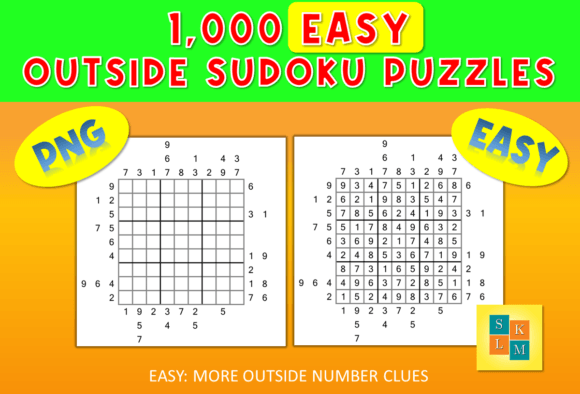
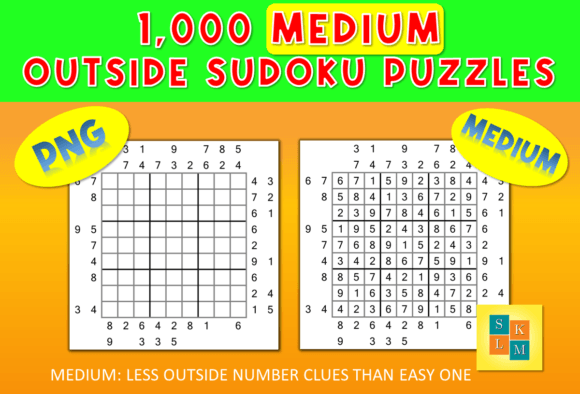
Most people know the classic 9×9 grid, but step just outside that familiar territory and you will find a variant that shifts the entire solving experience. The 1,000 SUDOKU Medium Outside Sudoku collection is exactly what it sounds like: a thousand carefully crafted puzzles where the clues live outside the grid rather than inside the cells. Instead of scattered given numbers across the board, you get hints along the perimeter that tell you which digits appear in the first three cells of a row or column from that direction. It sounds like a small twist, but it reshapes how your brain approaches deduction, pattern recognition, and logical sequencing.
This particular bundle lands at a medium difficulty sweet spot. Not the gentle warm-up of easy puzzles where the path practically lights up for you, and not the grueling marathon of hard or expert grids that can leave you staring for an hour. Medium means engagement without exhaustion. And with a thousand of them, you are not just buying a puzzle book; you are sitting on a deep reservoir of content that can be repurposed, printed, shared, taught, and enjoyed across wildly different settings.
Why Outside Sudoku Feels Different from the Classic Game
Standard Sudoku gives you internal anchors. A few numbers sit inside the grid, and you build outward from those known quantities. Outside Sudoku inverts that relationship. The outside clues function like a lens—they narrow down what can possibly occupy the border cells, and from there the logic ripples inward. Solvers often report that the first few minutes feel disorienting, almost like learning to write with the opposite hand. Then something clicks. Suddenly, scanning the perimeter becomes second nature, and the puzzle transforms into a layered process of elimination that feels fresher than the traditional format.
This shift matters for anyone who has hit a plateau with standard Sudoku. When your brain gets too comfortable with a particular solving algorithm, the challenge dulls. A variant like Outside Sudoku jolts you out of autopilot and re-engages your working memory and spatial reasoning in new ways. The medium difficulty in this 1,000 SUDOKU Medium Outside Sudoku set means the puzzles are substantial enough to trigger that cognitive stretch without becoming discouraging.
Publishing and the KDP Journey: A Ready-Made Asset
If you are building puzzle books for Amazon KDP, Etsy printables, or any print-on-demand platform, you already know the bottleneck: content creation. Sourcing or generating a thousand quality puzzles from scratch can eat weeks of time. Formatting them consistently, verifying solutions, and ensuring they look crisp in print adds another layer of labor. This bundle removes that entire headache.
The files arrive as high-resolution PNGs inside a zipped folder. Each puzzle and its corresponding solution are separate images, which gives you enormous flexibility. You can drop them into a book template at whatever size suits your trim dimensions. You can arrange them two per page with the solution at the back, or position the puzzle on the left page and the solution on the right for a coil-bound workbook feel. Because the images are raster rather than embedded in a rigid PDF, you control the layout without wrestling with someone else's formatting decisions.
For KDP creators specifically, the high-resolution aspect is non-negotiable. Amazon's print quality can amplify any fuzziness in source images, and nothing triggers returns faster than puzzles that are hard to read. These PNGs maintain clarity at print resolution, so the grid lines stay sharp and the numbers remain legible even on cream or off-white paper stocks that can sometimes wash out thinner line work.
Classroom and Educational Environments
Teachers and educators constantly hunt for activities that occupy early finishers, provide structured breaks, or reinforce logical thinking without feeling like extra homework. Outside Sudoku fits neatly into that gap. The medium difficulty means middle school students and up can tackle them independently, and the variant format introduces an element of novelty that holds attention better than another worksheet of standard problems.
Math teachers might use a handful of these puzzles during a unit on deductive reasoning or set theory. The outside clues essentially give you subsets of digits, and working out what fits where is an applied exercise in constraints and intersections. It is logic dressed up as a game, and students often do not notice they are building transferable reasoning skills until you point it out afterward.
Beyond math, these puzzles work well in study hall rotations, library activity stations, or even as a calm-down option in counseling offices. Printing them in batches means you always have something on hand that requires no instruction beyond a quick demonstration of how the outside clues function. And because there are a thousand of them, you will not run through the stack before the semester ends.
Seminar Breaks, Workshops, and Corporate Settings
Anyone who has organized a full-day workshop knows the rhythm challenge. You need breaks, but you also want to keep minds engaged rather than letting them scatter entirely into phone-scrolling and email-checking. A puzzle station stocked with printed Outside Sudoku sheets offers a screen-free mental reset that participants can pick up and put down without pressure.
Facilitators in creative industries, tech, and consulting have used puzzle breaks as a subtle way to shift brain modes between sessions. After an intense strategic planning block, working through a medium-difficulty logic puzzle activates different cognitive pathways. It is relaxing but not passive, focused but not draining. The social element can emerge too when two people lean over the same grid and start collaborating, which is a small bonding moment in an otherwise structured environment.
Because this 1,000 SUDOKU Medium Outside Sudoku collection is organized and solution-verified, you do not have to worry about someone hitting an unsolvable puzzle and walking away frustrated. Every grid has a clean, logical path from the outside clues to the completed board, and the solution images confirm it.
Family Gatherings and Multi-Generational Fun
Board games and card games dominate family entertainment, but they require a critical mass of willing participants and often a chunk of uninterrupted time. Puzzles occupy a different niche. They are quiet, individual or paired activities that coexist alongside conversation. Someone can sit with a cup of coffee and an Outside Sudoku grid while others chat, drifting in and out of the solving as they like.
The medium difficulty level opens the activity to a broad age range. Teenagers who find easy puzzles trivial can dig into these without feeling condescended to. Adult children visiting parents might print a few sheets to leave behind, knowing that regular puzzle-solving correlates with cognitive maintenance in older adults. Grandparents and grandkids can even work side by side on different puzzles, sharing the same activity at different paces.
What makes Outside Sudoku particularly good for family settings is the conversation starter built into the variant itself. Someone inevitably asks, "Wait, how does this work?" and the quick explanation of the outside clues becomes a small teaching moment. It is accessible enough that a curious ten-year-old can grasp the rules, yet challenging enough that the adults do not breeze through and lose interest.
Senior Centers, Memory Care, and Cognitive Wellness
Activity directors in senior living communities are always seeking engaging, dignified mental stimulation. Crossword puzzles can be vocabulary-dependent and culturally specific. Word searches sometimes feel infantilizing to sharp older adults. Sudoku in its standard form has wide appeal, but adding the outside variant introduces novelty without complexity, which is a delicate balance to strike.
Medium difficulty Outside Sudoku provides a meaningful cognitive workout: sustained attention, logical sequencing, working memory, and pattern recognition all come into play. The outside clues give a different kind of entry point into the puzzle, which can feel more structured and less overwhelming than staring at a nearly empty grid with only a handful of internal givens. For someone who struggles with visual scanning across a full 9×9 looking for the next move, the perimeter-based clues offer a systematic way to approach the solve.
Printing these at larger sizes—which the high-resolution PNGs easily support—makes them accessible to older adults with minor vision challenges. A full-page print of a single puzzle with bold, clear grid lines can turn a frustrating small-print experience into a comfortable, enjoyable activity. Facilities can build a rotating library of printed puzzles without ever repeating, thanks to the sheer volume of the collection.
Streamlining Your Workflow: Formats, Tools, and Practical Considerations
The zipped folder structure matters more than it might seem at first glance. Having one thousand individual puzzle images and one thousand matching solution images means you can batch-process them, rename them systematically, or pull subsets without unwinding a monolithic document. For KDP creators, this granularity allows you to build multiple smaller books from the same source—perhaps a 200-puzzle volume, then a second volume, or themed collections.
The included tool recommendation is worth noting for anyone on a tight production schedule. Mass-handling a thousand image files can become unwieldy without the right software. Knowing which tool to use for resizing, batch conversion, or insertion into a document template saves hours of trial and error. If you need specific file types beyond the provided PNGs—vectors, transparent-background versions, or different formats for a particular printing setup—the seller mentions openness to feedback, which suggests flexibility for future updates.
One consideration worth keeping in mind: these are raster images, not scalable vectors. PNGs at high resolution print beautifully at standard book sizes, but if you need to blow a puzzle up to poster scale for a classroom wall or a large-print edition, you may hit the limits of the format. For most KDP trim sizes—6×9, 8.5×11, and everything in between—the resolution holds up without issue.
Another practical note is that the Outside Sudoku variant requires a brief rules explanation if your audience has never encountered it. While the solving community is familiar with variants, the general puzzle audience may need a sentence or two of instruction. If you are publishing a book, include a clear, illustrated example page at the front. If you are using them in a classroom, a quick demo on a whiteboard sets everyone up. The learning curve is shallow, but it exists.
Who Gets the Most Out of This Collection
The 1,000 SUDOKU Medium Outside Sudoku bundle appeals to overlapping circles of users. The KDP entrepreneur values the volume, resolution, and time savings. The teacher or workshop facilitator values the ready-to-print engagement tool. The family values the shared, screen-free activity that accommodates different ages and skill levels. The senior activity coordinator values the cognitive benefit and the dignified challenge. And the individual puzzle enthusiast values the thousand fresh grids that push beyond the standard format without veering into punishing difficulty.
Medium difficulty is the unifying thread. It is not a beginner's introduction, nor is it a specialist's deep dive. It occupies the broad middle ground where most puzzle lovers actually spend their time—challenged enough to stay interested, capable enough to finish. That makes the collection versatile in a way that an all-easy or all-hard set would not be.
Whether you are looking to publish, teach, entertain, or simply disappear into a logic puzzle for twenty minutes, having a thousand of them at your fingertips changes the equation. You stop rationing puzzles and start using them freely, exactly as they were meant to be used.