Organize Your Finances Effortlessly with a Bill Payment Tracker for KDP
Most people juggle multiple payment deadlines every month—rent or mortgage, utilities, credit cards, subscriptions, insurance, and more. Even one missed due date can trigger late fees, service interruptions, or a hit to your credit score. A Bill Payment Tracker for KDP offers a refreshingly straightforward way to bring order to that chaos. It’s not an app, not a spreadsheet you have to build from scratch, but a clean, printable interior designed specifically for self-publishers who want to sell a functional financial logbook on Amazon.
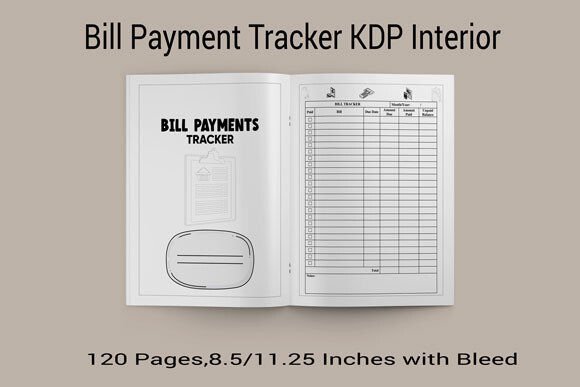
The downloadable ZIP package contains everything you need to create a polished 120-page notebook. You get a PDF file that’s 100% ready for KDP uploading, plus editable AI and JPEG versions. The dimensions are fixed at 8.5×11 inches with bleed included, so the final printed book will have a professional trim without any white edges cutting into your layout. Whether you’re a creator building a low-content publishing brand, a coach looking for client resources, or simply someone who wants a personal system to track bills, this interior removes the heavy lifting and lets you focus on what matters—staying on top of payments.
Everyday Scenarios That Demand a Reliable Bill Organizer
Picture a quiet Sunday evening at the kitchen table. You’ve got a stack of envelopes, a laptop open to your bank’s website, and a mental list that feels like it’s about to slip through the cracks. This is the exact moment a physical bill tracker shines. Instead of switching between tabs or scrolling through auto-generated statements, you open a dedicated logbook. You write down the biller, the amount, the due date, and a quick confirmation once it’s paid. The process feels tactile and deliberate, which makes it less likely you’ll overlook something.
The same tool finds its place in a home office where a freelancer monitors irregular income and recurring business expenses. It sits in a binder that a small business owner flips through during weekly check-ins. It’s on the desk of a recent graduate learning to manage rent, student loans, and streaming subscriptions for the first time. Because the tracker follows a consistent format month after month, it becomes a habit anchor—something you reach for whenever a billing cycle closes or a new statement arrives. People also use it during January financial reviews, before tax preparation, or when they’re trying to cut unnecessary subscriptions and need a clear audit of what goes out each month.
Why a Simple Paper Tracker Outperforms Complex Apps
Digital tools promise automation but often deliver distraction. Notifications interrupt your focus. Apps update and change their interface. Some require sharing sensitive financial data with third-party servers. A printable bill tracker, on the other hand, keeps everything local and private. There’s zero learning curve. You don’t have to watch a tutorial or read a help article. You just write.
For many, this offline approach reduces anxiety. When you manually log each bill, you’re more aware of your spending patterns. You’re less likely to treat payments as background noise. The act of writing cements accountability in a way that automatic bank drafts can’t. And because the KDP interior comes in a generous 8.5×11 format, you have plenty of room to jot notes, highlight priority bills, or even use different colored pens to categorize expenses. The 120 pages provide enough space to track regularly for a full year or more, depending on how you structure your entries.
How Different People Put the Tracker to Work
Use cases stretch far beyond the obvious monthly checklist. A freelance writer might use the tracker to separate business and personal bills, noting which payments are tax-deductible. Each page becomes a mini record that simplifies quarterly estimated tax calculations. A couple sharing household expenses can keep the logbook in a common area, updating it together so both partners know exactly what’s been paid and what’s pending—this alone reduces countless arguments about money.
A small retail shop owner prints the interior multiple times to create a durable spiral-bound book. Each month gets its own section where utility bills, vendor payments, and subscription services are logged alongside handwritten notes about cash flow. When an accountant requests expense records, the book serves as a clear paper trail. Meanwhile, a college student living off-campus for the first time uses a simplified version: due date, company, amount, checkbox for paid. That minimal setup builds a lifelong habit of financial awareness without overwhelming someone who’s new to managing money.
Educators and coaches find value here too. A financial literacy teacher can download the AI or PDF file, tweak the layout slightly to match a lesson plan, and print copies for a classroom workshop. A life coach might include the tracker as part of a client’s organization binder, pairing it with goal-setting pages. Because the interior is provided with editable files, you’re not locked into only the pre-designed layout—you can adjust column headings, add branding, or remove sections to fit specific audiences.
Freelancers and Gig Workers
Variable income makes bill timing tricky. When you log every obligation, you can quickly see which weeks are heavy and plan client work accordingly. The tracker also serves as proof of payment for business expenses at tax time, reducing the scramble to find receipts.
Families and Household Managers
Juggling mortgage, car payments, insurance, and multiple utility accounts becomes manageable. A shared logbook means no more “I thought you paid that” moments. Some families even turn it into a quick weekly review ritual, using the tracker to talk about the upcoming week’s bills and adjust grocery spending if needed.
Small Business Owners
Separating business and personal finances is non-negotiable. A dedicated bill tracker for the business side keeps vendor payments organized and builds a reliable backup to digital accounting software. If the internet goes down or an app crashes, the paper record is still there.
Students and Young Adults
For those building credit and learning financial independence, the simplicity of a pen-and-paper tracker removes intimidation. There are no fancy features, no analytics—just a clear spot to write down what’s due and when it’s paid. That straightforward approach builds confidence quickly.
Creators and Hobby Publishers
This isn’t just a product to use—it’s one to sell. If you already run a KDP business focusing on planners, journals, or financial tools, adding a bill payment tracker to your catalog expands your niche. The ready-to-upload PDF means you can go from download to live listing in under an hour. The editable AI and JPEG files allow you to insert your own branding, tweak the cover design, or create an entire series with matching interiors.
Making the Tracker Work for You Over 120 Pages
One interior offers plenty of flexibility. Some users will start at page one and work sequentially through all 120 pages, using two pages per month. Others might assign different sections to different categories: one chunk for fixed monthly bills like rent and car payments, another for variable expenses like credit cards and electric bills. You could even reserve the last 10 pages for a year-end summary, noting which months ran higher than expected and why.
If you’re using colored pens or highlighters, the 8.5×11 inch page gives ample white space for color-coding without feeling cluttered. For those who prefer a minimalist look, the clean design keeps the focus on the numbers and due dates. And because the interior includes bleed, any KDP-printed book will have ink that extends fully to the edge—no unprinted margins that make a notebook feel amateurish. That’s a small detail that customers notice when they receive a professionally formatted book.
What to Keep in Mind Before You Download or Publish
Before you upload the PDF to KDP, double-check the bleed settings in your account to match the file specifications. The interior is already sized correctly, but you’ll want to confirm your cover file aligns with the 8.5×11 trim size. If you plan to modify the interior using the AI or JPEG files, make sure any added text or graphics remain within the safe zone to avoid getting cut off during printing.
Think about your audience. A bill tracker that works for a freelancer might not immediately appeal to someone managing a large family budget unless the design is flexible enough. Since the editable files let you adjust categories and headings, consider creating niche variations—like a tracker specifically for small business owners or one tailored to rental property expenses. That kind of customization can set your KDP listing apart in a competitive category.
Also, consider the user experience after purchase. A 120-page book is substantial. If you’re selling it on Amazon, make sure your description clearly explains the page count, size, and how the layout functions. When customers know exactly what they’re getting, returns drop and reviews improve.
From a ZIP File to a Finished Notebook That Sells
The zip package’s real value lies in what it saves you. Designing a 120-page interior from scratch, accounting for bleed, and ensuring KDP compatibility can take days if you’re not a graphic designer. Here, you receive a tested, print-ready PDF that meets Amazon’s requirements out of the box. The inclusion of AI and JPEG files means you’re not stuck with one look forever—you can adapt the interior for future releases, bundle it with other planners, or use it as a lead magnet if you run a financial coaching business.
For the everyday user, having a physical, well-structured bill tracker changes how you interact with money. Instead of dreading bill day, you have a routine. Instead of scattered mental notes, you have a single source of truth. And for creators, offering that kind of practical, life-improving tool builds a brand people trust. The tracker doesn’t promise miracles; it simply gives anyone a clear space to write things down, stay accountable, and move through each month with less financial noise.