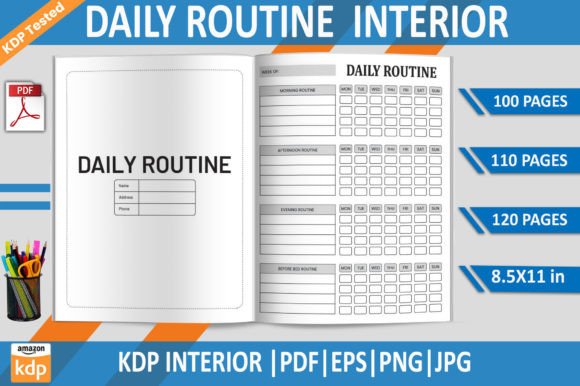
Simplify Publishing with Daily Routine KDP Interior Template
Creating a polished daily planner or journal interior for Amazon KDP can feel like a puzzle. You need the right page dimensions, a clean layout, and files that pass KDP’s automated checks without hiccups. The Daily Routine KDP Interior Template removes that friction. It’s a ready-to-upload, professionally structured design package that includes everything from fully tested PDFs to editable source files, all formatted at 8.5×11 inches with crisp 300 DPI clarity. Instead of spending hours tweaking margins or rebuilding artwork from scratch, you download the files, optional customize them, and move straight to publishing. For busy creators, freelancers, and small business owners, that kind of efficiency directly translates into more launches, less stress, and a quicker path to passive income.
What Is a Daily Routine KDP Interior Template?
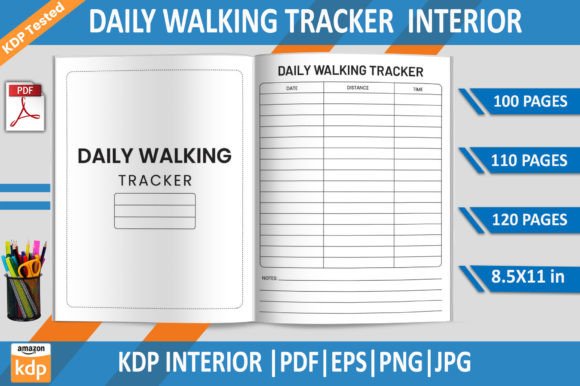
At its core, this Daily Routine KDP interior template is a collection of pre-designed page files meant for everyday planning, journaling, or diary-style notebooks sold on Amazon KDP. Unlike generic blank templates, it’s built specifically around the structure of a daily routine log—think prompts for morning intentions, evening reflections, or habit trackers. The package includes three PDF page-count variations: 100 pages, 110 pages, and 120 pages. This gives you immediate flexibility. If you’re publishing a compact 90-day journal, the 100-page PDF gets you close; if you want a slightly thicker paperback, the 120-page version adds substance without extra design work. All files are no-bleed, which simplifies the print process and matches the requirements of many KDP notebooks. Additionally, you receive an editable EPS file for Adobe Illustrator users, plus high-resolution PNG and JPG copies with transparent backgrounds where relevant. It’s a multi-format safety net that ensures you’re not locked into one editing environment.
The phrase “100 Tested” in the product description is more than marketing—it signals that someone has already uploaded a version of these exact files to KDP and confirmed they print correctly. For independent publishers who dread the “your file has errors” email, that pre-testing is a quiet but substantial relief. The developer ran a quality check, so you’re starting with a proven baseline. While every KDP upload still deserves a personal preview, a tested file dramatically reduces the chance of rejection due to margin misalignment, low resolution, or odd transparency layers.
Why Pre-Tested Files Matter for Self-Publishers
Amazon KDP’s print review process can be opaque. Sometimes a file looks perfect on screen, yet the automated system flags it for image size or unflattened layers. With a daily routine KDP interior that’s already been uploaded and approved, you step over that initial hurdle. The PDFs are formatted as print-ready documents, with no bleed requirements to complicate matters. Because the dimensions are a common 8.5×11 inches, the template fits neatly into the “Large Print” or notebook category, where customers often expect ample writing space. By starting with tested files, small business owners and hobbyists can dramatically shrink the trial-and-error phase that many first-time publishers experience. You spend less time resizing and more time on the creative parts—like tailoring the inside pages to your unique audience, adding branding, or adjusting the daily prompt labels.
Think of it as borrowing a successful framework. The template provides the structural foundation that KDP’s system already recognizes as acceptable. That doesn’t guarantee every single variation will pass without a manual review, but it establishes a strong technical foundation. For professionals juggling multiple projects, that reliability is a productivity multiplier. Instead of proofing every millimeter, you can trust the base geometry and focus on content, such as whether your daily routine layout works well for morning journaling or evening goal setting.
Key Features That Support a Smooth Workflow
The deliverable package goes beyond a single PDF. The inclusion of multiple file types means you can adapt the daily routine KDP interior template to different stages of your publishing pipeline:
- PDF File 100 pages / 110 pages / 120 pages – These are your immediate upload options. You can use them as-is for a complete interior or combine pages to reach your desired length. Because they’re print PDFs, no conversion step is required; KDP accepts the format natively.
- EPS File – The editable vector version. This is where Adobe Illustrator support truly shines. Open the EPS in Illustrator, and you gain full control over fonts, line styles, and layout elements. You can swap headings, adjust daily routine sections, or even convert the template to a different style entirely, all without losing print quality.
- PNG and JPG Files – High-resolution 300 DPI raster files. The PNGs come with transparent backgrounds, which is useful if you want to layer the page design over a custom background in software like Canva or Photoshop. The JPGs provide a flat, quick-reference version for previewing or sharing with collaborators.
- No Bleed Format – This simplifies design because you don’t need to extend images beyond the trim line. Many journals and notebooks on KDP thrive with no-bleed interiors, so you avoid the complexity of managing inside margin shifting.
Each file operates at a consistent 8.5×11 inches at 300 DPI, which guarantees sharp text and crisp lines when printed. For readers who use ink pens or markers, that clarity contributes to a premium feel. While the template doesn’t dictate a specific color palette (you can adjust that in the EPS or PNG layers), its black-and-white readiness makes it cost-effective for KDP’s printing rates and incredibly publisher-friendly.
Editable Formats: Not Just for Graphic Designers
A common hesitation among non-designers is the fear of complex software. However, the editable EPS file is built for Adobe Illustrator, a vector program, yet you don’t need to be an expert to make simple changes. Even opening the EPS, editing placeholder text like “Date” or “Daily Gratitude,” and saving back out is learnable in minutes. If you prefer a more visual approach, the PNG files with transparent backgrounds can be imported into Canva, where you overlay text boxes or icons. Many successful KDP creators use Canva to add custom touches—changing a “Morning Routine” header to a specific brand phrase, for instance—without touching code or scripts. The transparent background PNG essentially gives you a versatile asset: place it on any color background, duplicate it, and build a full interior PDF using simple drag-and-drop tools.
For those who do run Illustrator or Affinity Designer, the EPS file is a powerful starting point. You can transform a dedicated daily routine layout into a more generalized lined journal by removing prompt fields, or you can intensify the daily planning aspect by adding habit checkboxes. The editable nature means the template can serve multiple niches: wellness planners, student daily logs, creative morning pages, or even business productivity diaries. The only real limit is your imagination and the time you wish to invest in customization.
Choosing the Right Page Count for Your Daily Journal
Selecting between 100, 110, and 120 pages might seem trivial, but it has a meaningful impact on the final product’s thickness, perceived value, and price point on KDP. A 100-page journal feels relatively slim and lightweight, ideal for a travel-friendly daily companion or a 90-day challenge book. The 120-page version adds just enough heft to feel substantial without being unwieldy. If you’re targeting the “daily reflection” space, 110 pages splits the difference nicely, giving you roughly 55 sheets of paper. Consider your target audience: a busy professional might prefer a lighter notebook that slides into a laptop bag, while a dedicated journaler might appreciate the permanence of more pages. The template provides all three so you can test different versions in KDP’s print simulator or even publish variants under separate ASINs to see what resonates.
Because the files are print-ready PDFs, swapping page counts is straightforward. You can also combine files: start with the 120-page PDF as your base, then edit and insert a few custom pages from the EPS version to create a hybrid interior. The structural consistency across all page counts means the daily routine layout remains uniform, maintaining a professional appearance regardless of the final length.
Who Gains the Most from This Template?
While the Daily Routine KDP Interior Template serves a broad audience, a few groups stand to benefit disproportionately. First, authors and publishers expanding into print-on-demand journals can avoid the steep learning curve of interior design. Instead of watching tutorial after tutorial, they grab a tested file, optionally personalize it, and list a new product in a day. Second, creativity coaches and productivity bloggers can use the template as a foundation for their own branded daily planners. By editing the EPS, they can add their logo, change headers to match their program terminology, and create a physical product that reinforces their brand identity. Third, freelancers offering KDP design services appreciate the time savings. A client needs a daily routine notebook fast? You load the EPS, make custom changes, and deliver a high-quality interior without building every element from zero.
Even hobbyists exploring a side income stream find the template accessible. Without graphic design skills, they can open a PDF, upload it to KDP, design a cover that pairs well, and have a live listing. The template’s no-bleed design also makes cover creation simpler because you don’t have to account for image wrapping around the spine in a complex way. The combination of ease and proven compatibility lowers the barrier to entry so that someone working a day job can publish a daily routine journal on evenings and weekends with realistic expectations of quality.
Potential Considerations Before You Purchase
No single template can satisfy every publishing need, and it’s wise to examine where this one might require a complementary approach. The no-bleed format, while convenient, means that if you envision a journal with full-page background images that run to the edge, you’ll need to modify the file or select a different template. Additionally, the 8.5×11 size is standard but not the only size customers seek; those targeting a 6×9 or A5 market might need to resize, which the EPS file can accomplish, though it demands attention to proportional scaling. Also, while the files are KDP tested, Amazon’s systems occasionally change, so a quick preview on the KDP Bookshelf after upload is always recommended. Think of the testing as a snapshot of proven quality at the time of development—consistent reliability, but not a permanent guarantee against every future system quirk.
Furthermore, if your daily routine concept involves highly specialized prompts (for example, a medical symptom tracker or a highly specific business framework), you’ll need to invest time editing the EPS. The template provides a clean, neutral daily layout; the more you deviate from its structure, the more design work you take on. That’s not a drawback—it’s a feature of an editable product—but it’s helpful to set realistic expectations. The template accelerates the process, but it doesn’t magically design your entire vision without a few clicks.
Best Practices for Using the Template on KDP
To get the most from your daily routine KDP interior template, start by opening the PDF version closest to your target page count and flipping through every page digitally. This helps you catch any small alignment quirks that might appear after editing. If you’ll be customizing the EPS, work in Adobe Illustrator and maintain the original artboard size. When exporting your final press-ready PDF, double-check that you’re using a PDF/X-1a standard or whatever KDP currently recommends, and confirm that all text has been converted to outlines if you’re using fonts that might not embed properly. Although the template likely already handles font embedding, this step is a safety net.
For those who want to add a personal touch without Adobe software, use the transparent background PNG files. In Canva, create a document of 8.5×11 inches at 300 DPI, place the PNG as a background, then add your own text boxes, decorative illustrations, or date headers. Group all layers, download as PDF Print, and you have a unique interior that still rests on a tested base. This workflow works for people who want to sell a “Daily Routine for Moms” or “Freelancer’s Daily Log” without drawing elaborate layouts from scratch.
Always do a test print through KDP’s ordering system before publishing publicly. Order an author copy and flip through it physically. Digital previews can miss subtle contrast issues or line weight concerns. A single physical proof validates that the daily routine layout feels right in hand, the page counts are correct, and the binding doesn’t cut off important content. The template’s pre-tested nature gives you confidence, but your unique modifications deserve their own real-world verification.
From Concept to Published Book: A Realistic Example
Let’s say you’re a wellness coach who wants to publish a “Mindful Daily Routine Journal.” You download the template package, open the 110-page PDF, and decide that the existing layout with sections for morning intention, mid-day check-in, and evening reflection matches your philosophy perfectly. You spend an hour in Illustrator editing the section titles to reflect your brand voice—maybe “Morning Clarity” instead of “Morning Routine.” You add a subtle logo on the page bottom using the EPS file, export to PDF, and upload. Within a week, you’re holding a proof copy that feels cohesive and premium. Without the template, that same coach might spend days struggling with margin settings or deciphering KDP’s bleed guidelines. The template doesn’t eliminate work, but it handles the technical burden so you can direct energy toward value-added customization.
For many self-publishers, the most significant outcome isn’t just a faster launch; it’s reduced decision fatigue. You’re not second-guessing whether the PDF will fail the KDP checker, whether the resolution is adequate, or whether you chose the right size. Those decisions are already handled competently. That mental bandwidth can now go to marketing, cover design, and customer research—activities that truly differentiate a product in a crowded marketplace.
While the Daily Routine KDP Interior Template won’t build your entire publishing empire overnight, it functions as a reliable, multi-format asset that bridges the gap between an idea and a tangible book. Its combination of tested PDFs, editable EPS, and transparent PNGs covers a wide range of workflows, from drag-and-drop simplicity to deep vector editing. For adults navigating the intersection of creativity and commerce—whether they’re educators crafting classroom journals, entrepreneurs launching a product line, or bloggers extending their brand—this template represents a pragmatic shortcut. It removes a repetitive, technical layer of self-publishing so you can spend more time crafting the content that your readers will actually engage with each morning or night. In a world where time matters as much as money, that kind of thoughtful design support holds genuinely practical value.